


Resources
A collection of free resources to help you raise funds and share the work we do


About our charity
The Mission to Seafarers provides help to the 1.89 million people who face danger every day to keep our global economy afloat.

What is a seafarer
Support for anyone working in the seafaring industry
Our impact
Providing help for seafarers in over 200 ports around the world.
Our issues
Multiple issues effect Seafarers everyday, learn how we help
Our people
Learn more about the staff that make change happen
Careers
Impacts on the lives of people across the world
Publications
Explore our latest publications, reports, and stories showcasing the impact of our work.

Back
About our charity
The Mission to Seafarers provides help to the 1.89 million people who face danger every day to keep our global economy afloat.
What is a seafarer
Support for anyone working in the seafaring industry
Our impact
Providing help for seafarers in over 200 ports around the world.
Our issues
Multiple issues effect Seafarers everyday, learn how we help
Our people
Learn more about the staff that make change happen
Careers
Impacts on the lives of people across the world
Publications
Explore our latest publications, reports, and stories showcasing the impact of our work.

Where can I get help?
We are here for you 24/7

Download our app
The first digital seafarers’ centre in your pocket.

Find a port
We’re located in over 200 ports in 50 different countries
Family network
Learn more about the community we’re building for seafarers’ families
The Sea
The latest maritime news and safety information for seafarers.
WeCare
An initiative designed to improve the mental health and wellbeing of seafarers
Training
We have a range of e-learning for seafarers and their families
Seafarers happiness index
A platform for seafarers to share their views and be a catalyst for change
Contact our Chaplaincy team
Support for anyone working in the seafaring industry
Back
Where can I get help?
We are here for you 24/7
Download our app
The first digital seafarers’ centre in your pocket
Find a port
We’re located in over 200 ports in 50 different countries
Family network
Learn more about the community we’re building for seafarers’ families
The Sea
The latest maritime news and safety information for seafarers.
WeCare
An initiative designed to improve the mental health and wellbeing of seafarers
Training
We have a range of e-learning for seafarers and their families
Seafarers happiness index
A platform for seafarers to share their views and be a catalyst for change
Contact our Chaplaincy team
Support for anyone working in the seafaring industry

Make a donation
With your help we can be there for everyone that needs us

Events
Learn more about our global programme of events

Legacy
Support us with a legacy gift.
Back
Make a donation
With your help we can be there for everyone that needs us
Events
Learn more about our global programme of events
Legacy
Support us with a legacy gift.
October 2026
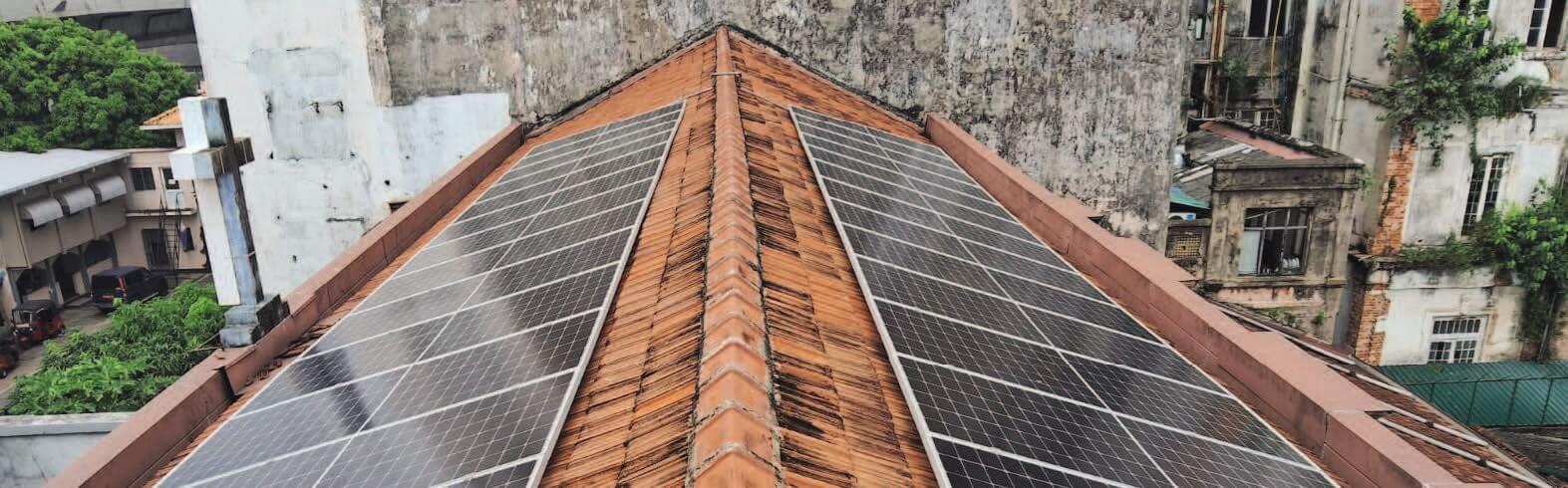
The story began in late 2024, when our centre in Colombo installed rooftop solar panels. Energy costs were rising and the Mission wanted a solution that would be kinder to the planet, so Sri Lanka’s abundant sunshine made the choice an easy one.
“The solar panels were installed while Sri Lanka was in the grip of a serious economic and energy crisis, so for us, this has proved to be more than just a lifeline,” explains Fr Perry Brohier, port chaplain in Colombo.
The investment paid off. Within 12 months, electricity-related emissions had fallen by 95%, while CO₂ emissions halved from 2.2 tonnes in 2024 to 1.1 tonnes in 2025.
Human impact
Sustainability initiatives sometimes feel like they are competing with frontline spending, but Colombo tells a different story. With the centre’s electricity bill falling by 60%, money was reinvested directly into work with seafarers.
“The savings have opened up real space for seafarer welfare initiatives. Looking ahead, the option of electric vehicles has also been considered as a next step,” continues Fr Perry.
Global uptake
Ports in Panama, the UAE, Australia, Georgia and Indonesia are also going greener, using hybrid vehicles, thanks to an investment of around £123,000 from the ITF Seafarers’ Trust.
“For us, this isn’t simply about solar panels or reducing an electricity bill. It’s about finding practical ways to make sure more of the resources entrusted to us can reach the seafarers we serve,” says Revd John Attenborough, Regional Director for the Middle East and South Asia.
As Colombo has shown, going green doesn’t just benefit the planet; it also means more resources for what matters most: being there for seafarers.
1.89 million people work at sea, and with your help we can be there for everyone that needs us.