


Resources
A collection of free resources to help you raise funds and share the work we do


About our charity
The Mission to Seafarers provides help to the 1.89 million people who face danger every day to keep our global economy afloat.

What is a seafarer
Support for anyone working in the seafaring industry
Our impact
Providing help for seafarers in over 200 ports around the world.
Our issues
Multiple issues effect Seafarers everyday, learn how we help
Our people
Learn more about the staff that make change happen
Careers
Impacts on the lives of people across the world
Publications
Explore our latest publications, reports, and stories showcasing the impact of our work.

Back
About our charity
The Mission to Seafarers provides help to the 1.89 million people who face danger every day to keep our global economy afloat.
What is a seafarer
Support for anyone working in the seafaring industry
Our impact
Providing help for seafarers in over 200 ports around the world.
Our issues
Multiple issues effect Seafarers everyday, learn how we help
Our people
Learn more about the staff that make change happen
Careers
Impacts on the lives of people across the world
Publications
Explore our latest publications, reports, and stories showcasing the impact of our work.

Where can I get help?
We are here for you 24/7

Download our app
The first digital seafarers’ centre in your pocket.

Find a port
We’re located in over 200 ports in 50 different countries
Family network
Learn more about the community we’re building for seafarers’ families
The Sea
The latest maritime news and safety information for seafarers.
WeCare
An initiative designed to improve the mental health and wellbeing of seafarers
Training
We have a range of e-learning for seafarers and their families
Seafarers happiness index
A platform for seafarers to share their views and be a catalyst for change
Contact our Chaplaincy team
Support for anyone working in the seafaring industry
Back
Where can I get help?
We are here for you 24/7
Download our app
The first digital seafarers’ centre in your pocket
Find a port
We’re located in over 200 ports in 50 different countries
Family network
Learn more about the community we’re building for seafarers’ families
The Sea
The latest maritime news and safety information for seafarers.
WeCare
An initiative designed to improve the mental health and wellbeing of seafarers
Training
We have a range of e-learning for seafarers and their families
Seafarers happiness index
A platform for seafarers to share their views and be a catalyst for change
Contact our Chaplaincy team
Support for anyone working in the seafaring industry

Make a donation
With your help we can be there for everyone that needs us

Events
Learn more about our global programme of events

Legacy
Support us with a legacy gift.
Back
Make a donation
With your help we can be there for everyone that needs us
Events
Learn more about our global programme of events
Legacy
Support us with a legacy gift.
October 2026
The ports of Poti and Batumi are a vital bridge between Europe and Asia, and at the heart of what is known as the Middle Corridor. The World Bank predicts that trade through the corridor could triple to 11 million tonnes a year by 2030, compared to 2021 levels.
That growth is already evident in Batumi, which handled around 7.3 million tonnes of cargo in 2025 – double what it carried in 2024. Further north, Poti handles around 80% of Georgia’s container traffic.
The Mission’s strategy has always been to take welfare services directly to seafarers who need them, and with Sergo’s arrival in July 2025, things have been taking shape.
Starting at zero
After completing his initial training in London, Sergo returned to Georgia to get started. “We started at zero,” he recalls. “There was only me, my backpack and the knowledge I gained during training.” But before he could put that training into practice, there was a bigger challenge to overcome, “there was no trust.”
It’s taken months of liaising, meeting, background checks and administration to secure access to the ports and ships. “Over here you can’t just get a badge and visit a ship. It’s an entire process,” he explains.
Earning trust, one ship at a time
Access is only the first step. Authorisation opens doors, but there is no shortcut to building relationships with seafarers. Crews passing through the ports are largely Ukrainian, Russian or Turkish, and Sergo speaks Georgian, Russian and English, with a good knowledge of Armenian. Even so, to many of them, a chaplain offering support with no strings attached seemed too good to be true.
The very concept of welfare support was also alien, with most crews working exclusively in the Black Sea, where there are virtually no other chaplains.
As Sergo explains, most ship visitors are from local authorities, police or immigration, checking protocols. “So they [seafarers] think maybe I am also coming to get them in trouble,” he says.
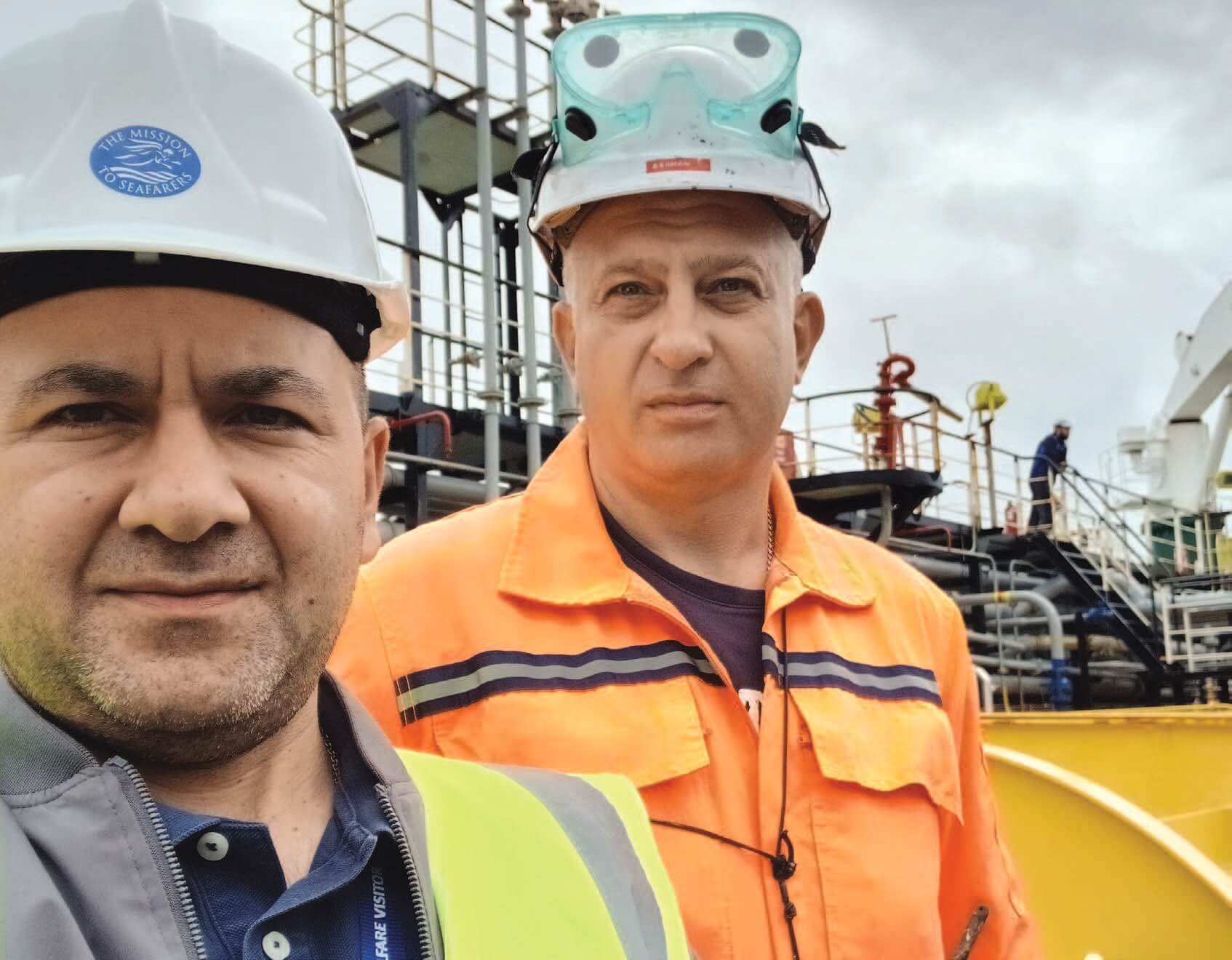
Sergo has worked hard to gain their trust and now visits between 30 and 50 ships each month, raising awareness of the Mission, driving seafarers into town and listening to their challenges.
“We can now go there freely, visit ships, talk with seafarers,” he says with pride. “They’re sharing information with each other, saying that there is a Mission to Seafarers chaplain and he’s good and supportive.”
“This means that tomorrow when they have a challenge, they can say, ‘OK, let’s go and see Sergo. He probably knows the port authorities, the ITF, all these people.’”
With the foundations firmly in place, Sergo is determined to build a team ready to respond to growth in the region, with more volunteers, better transport and even a seafarers’ centre.
“The only thing we are thinking about right now is progress,” he smiles.
1.89 million people work at sea, and with your help we can be there for everyone that needs us.