Resources
A collection of free resources to help you raise funds and share the work we do


About our charity
The Mission to Seafarers provides help to the 1.89 million people who face danger every day to keep our global economy afloat.

What is a seafarer
Support for anyone working in the seafaring industry
Our impact
Providing help for seafarers in over 200 ports around the world.
Our issues
Multiple issues effect Seafarers everyday, learn how we help
Our people
Learn more about the staff that make change happen
Careers
Impacts on the lives of people across the world
Publications
Explore our latest publications, reports, and stories showcasing the impact of our work.

Back
About our charity
The Mission to Seafarers provides help to the 1.89 million people who face danger every day to keep our global economy afloat.
What is a seafarer
Support for anyone working in the seafaring industry
Our impact
Providing help for seafarers in over 200 ports around the world.
Our issues
Multiple issues effect Seafarers everyday, learn how we help
Our people
Learn more about the staff that make change happen
Careers
Impacts on the lives of people across the world
Publications
Explore our latest publications, reports, and stories showcasing the impact of our work.

Where can I get help?
We are here for you 24/7
Download our app
The first digital seafarers’ centre in your pocket.

Find a port
We’re located in over 200 ports in 50 different countries
Family network
Learn more about the community we’re building for seafarers’ families
The Sea
The latest maritime news and safety information for seafarers.
WeCare
An initiative designed to improve the mental health and wellbeing of seafarers
Training
We have a range of e-learning for seafarers and their families
Seafarers happiness index
A platform for seafarers to share their views and be a catalyst for change
Contact our Chaplaincy team
Support for anyone working in the seafaring industry
Back
Where can I get help?
We are here for you 24/7
Download our app
The first digital seafarers’ centre in your pocket
Find a port
We’re located in over 200 ports in 50 different countries
Family network
Learn more about the community we’re building for seafarers’ families
The Sea
The latest maritime news and safety information for seafarers.
WeCare
An initiative designed to improve the mental health and wellbeing of seafarers
Training
We have a range of e-learning for seafarers and their families
Seafarers happiness index
A platform for seafarers to share their views and be a catalyst for change
Contact our Chaplaincy team
Support for anyone working in the seafaring industry

Make a donation
With your help we can be there for everyone that needs us

Events
Learn more about our global programme of events

Legacy
Support us with a legacy gift.
Back
Make a donation
With your help we can be there for everyone that needs us
Events
Learn more about our global programme of events
Legacy
Support us with a legacy gift.
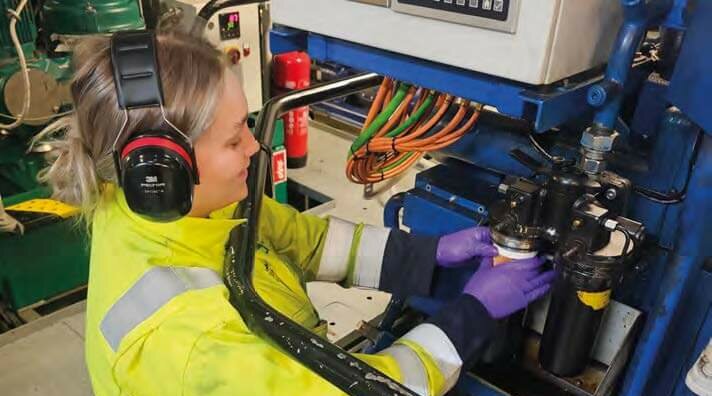
Carly Fields learns about Amilia Busby’s unconventional journey to seafaring
The maritime industry is often accused of being a closed shop, a business where traditions are handed down through generations and career paths are as rigid as a steel bulkhead. Yet, every so often, an individual emerges who breaks that archetype, proving that the modern seafarer is defined less by their lineage and more by their adaptability. Amilia Busby, a third engineer and recently crowned winner of the 2025 Nautilus Bevis Minter Award, is personification of that shift. Her journey from high-level rugby and construction sites to the engine room gives aspiration for the would-be seafarers of the future.
For many, the transition from the high-impact environment of competitive sports to the technical demands of marine engineering would seem like a leap too far. However, for Busby, the two worlds share a common language of resilience and collaboration. Reflecting on her time on the pitch, she identifies teamwork under pressure and the ability to effectively build connections as the primary skills she carried into her maritime career. She notes that when joining a new team, which she did frequently throughout her rugby career, it became natural for her to build connections with new teammates almost instantly.
This social intelligence has proven vital in the confined, high-stakes environment of a vessel. Busby describes a sophisticated approach to leadership and camaraderie that goes beyond simple co-operation. “I understand how to read the room, understanding different humour types, confidence levels, knowing who may need more support compared to the other person,” she explains. “You then get that sense of being a family and playing for each other, working as a team under pressure. All of these skills directly correlate to working on board. You work with different crews, have to adapt to different personalities, support your crew and most importantly work as a team under pressure.”
Career path
Busby’s path to the engine room was far from linear. Unlike many of her peers who may have grown up with a clear view of the horizon, her realisation came through the grit of the construction industry. After finishing a rugby academy in college, she found herself determined to avoid minimum-wage roles, leading her to work with her brother in steel fixing. She discovered a genuine love for being on-site, learning a trade, and reading technical drawings. There was also a deeper motivation at play: the drive to prove that, as a woman, she was more than capable of handling heavy labour and excelling in a traditionally male dominated trade.
A subsequent role in acoustic engineering further honed her technical mind. Despite starting with no knowledge of tools, she earned an NVQ within two years and became highly efficient. Her time in London, working on diverse sites, revealed a natural aptitude for the ‘why’ behind the ‘how’. She found that the way she read things was perfectly suited to engineering, as she constantly questioned designs and thought about methods differently, much like she did during mathematics in high school. Yet, acoustic engineering felt niche, prompting a search for something more expansive.
The discovery of the Merchant Navy was almost accidental. Despite having a grandfather who served as a submariner and deep-sea diver, Busby admits she had never heard of the industry until her boss mentioned it. A quick search for ‘marine engineering cadetship’ revealed a path that bypassed the financial burden of traditional university – a major selling point. “It was a very unconventional journey for me, without any mechanical engineering knowledge or even knowing how an engine worked at the time – I was really jumping in the deep end,” she says.
That unconventional path is something Busby now champions as a Careers At Sea Ambassador. She is quick to dispel the myth that a cadetship requires technical expertise. “I started with no prior knowledge of any content and had just worked in a few different trades. I had my GCSEs from school in maths and science and that’s all I needed.” While she admits to being apprehensive about the academic content, she praises the structure of the training system. She points out that the existence of different cadetship levels, such as the HND she pursued, allows students to be eased back into academics at a steady pace, even revisiting basics like adding and subtracting fractions. “That’s the beauty of it, if you have been out of education for a while, it doesn’t matter. You have the support and resources to learn the content and the course is set out with progressive learning and sea phases so you begin to apply the learning in the real life environment,” she says.
Industry transition
As a third engineer, Busby is entering the industry at a pivotal moment of technological transition. While she is modest about her current knowledge of alternative fuels, she has a clear vision of how the role of the engineer must evolve. “I think the role of a third engineer will become less mechanically intensive but more systems and safety driven, possibly requiring more competence in automation, hazard management and control systems while also keeping up with evolving regulations and safety,” she says.
Busby is optimistic about the direction of training, noting that cadetship curriculums are already changing to reflect net-zero targets. While her current experience on a coastal dredger involves marine gas oil, she emphasises that the responsibility for safety in the age of new fuels rests on comprehensive training. She argues that companies must supply relevant training for new technologies because they cannot hand over sole responsibility to a crew for systems they do not fully understand.
Sustainability, in Busby’s view, is not just about the ‘big’ technologies; it is a daily practice for the modern engineer. She sees sustainability as a core part of her day-to-day life, noting that engineers are directly responsible for energy efficiency, fuel consumption, and emissions. This involves practical habits like planning for just-in-time arrivals, avoiding the use of unnecessary machinery, utilising auxiliary power whenever possible, the meticulous management of garbage segregation and the handling of oily waste. “A lot of our daily maintenance has a direct correlation to sustainability and efficiency,” she says.
Hidden industry
Despite the rewarding nature of the work, Busby identifies a significant hurdle: the industry’s invisibility. As a Careers At Sea Ambassador, she argues that the biggest issue isn’t a misconception of the industry, but rather that it simply isn’t known enough. Even living in an East Sussex coastal town filled with fishing vessels, she had never heard of these career paths during her school years. She finds that promotion is often too focused on traditional maritime hubs, leaving many children in other areas to miss out on these opportunities. When she does speak at schools, she often encounters a narrow perception of life at sea, where students imagine “the North Sea and the videos you see of the ships with massive degrees of listing, rolling about the sea with ominous music in the background”.
Busby’s commitment to the community has culminated in the launch of the ShipMates Network. This initiative aims to bridge the isolation that can sometimes define a maritime career. She describes it as a global community for seafarers of all ranks and backgrounds, designed to be a “welcoming space to connect, share experiences, and support one another”. The idea was born from the realisation that seafarers often only meet the crew they work with before heading home for leave. By creating a professional group chat on a global scale, she hopes to encourage seafarers to network, exchange insights, and build relationships that support both professional growth and personal wellbeing.
Her own growth has been accelerated by her willingness to step outside the engine room and engage with the wider industry. Though she admits to feeling like an “imposter” at her first industry event, she quickly realised that the maritime world is eager to hear the voices of those actually serving at sea. She noticed she was often the only active seafarer in the room at such events and now urges others to say yes to these opportunities: “Go to the events, connect with industry professionals, build relationships … everyone wants to hear their voices.
“Hopefully I inspire the next generation of seafarers to get stuck in like I did, be the next leaders of our industry, sharing our thoughts and views, making change where it is needed and being supported and encouraged by the wide community behind them that can be the ShipMates Network.”
Looking ten years into the future, Busby sees herself remaining at sea, driven by the balance of dedicated work and the ability to return home to make valuable memories. While she acknowledges that future family life might eventually draw her toward a shoreside engineering role or policy work, her immediate focus remains on her community-building efforts. She is aspiring to build a significant community with the ShipMates Network, executing a wealth of ideas to support her peers. Whether she is managing a zero-emission engine or leading a global network of seafarers, Busby’s journey suggests that the most important tool in any engineer’s kit isn’t a wrench – it’s the courage to jump into the deep end.
1.89 million people work at sea, and with your help we can be there for everyone that needs us.