Resources
A collection of free resources to help you raise funds and share the work we do


About our charity
The Mission to Seafarers provides help to the 1.89 million people who face danger every day to keep our global economy afloat.

What is a seafarer
Support for anyone working in the seafaring industry
Our impact
Providing help for seafarers in over 200 ports around the world.
Our issues
Multiple issues effect Seafarers everyday, learn how we help
Our people
Learn more about the staff that make change happen
Careers
Impacts on the lives of people across the world
Publications
Explore our latest publications, reports, and stories showcasing the impact of our work.

Back
About our charity
The Mission to Seafarers provides help to the 1.89 million people who face danger every day to keep our global economy afloat.
What is a seafarer
Support for anyone working in the seafaring industry
Our impact
Providing help for seafarers in over 200 ports around the world.
Our issues
Multiple issues effect Seafarers everyday, learn how we help
Our people
Learn more about the staff that make change happen
Careers
Impacts on the lives of people across the world
Publications
Explore our latest publications, reports, and stories showcasing the impact of our work.

Where can I get help?
We are here for you 24/7

Download our app
The first digital seafarers’ centre in your pocket.

Find a port
We’re located in over 200 ports in 50 different countries
Family network
Learn more about the community we’re building for seafarers’ families
The Sea
The latest maritime news and safety information for seafarers.
WeCare
An initiative designed to improve the mental health and wellbeing of seafarers
Training
We have a range of e-learning for seafarers and their families
Seafarers happiness index
A platform for seafarers to share their views and be a catalyst for change
Contact our Chaplaincy team
Support for anyone working in the seafaring industry
Back
Where can I get help?
We are here for you 24/7
Download our app
The first digital seafarers’ centre in your pocket
Find a port
We’re located in over 200 ports in 50 different countries
Family network
Learn more about the community we’re building for seafarers’ families
The Sea
The latest maritime news and safety information for seafarers.
WeCare
An initiative designed to improve the mental health and wellbeing of seafarers
Training
We have a range of e-learning for seafarers and their families
Seafarers happiness index
A platform for seafarers to share their views and be a catalyst for change
Contact our Chaplaincy team
Support for anyone working in the seafaring industry

Make a donation
With your help we can be there for everyone that needs us

Events
Learn more about our global programme of events

Legacy
Support us with a legacy gift.
Back
Make a donation
With your help we can be there for everyone that needs us
Events
Learn more about our global programme of events
Legacy
Support us with a legacy gift.
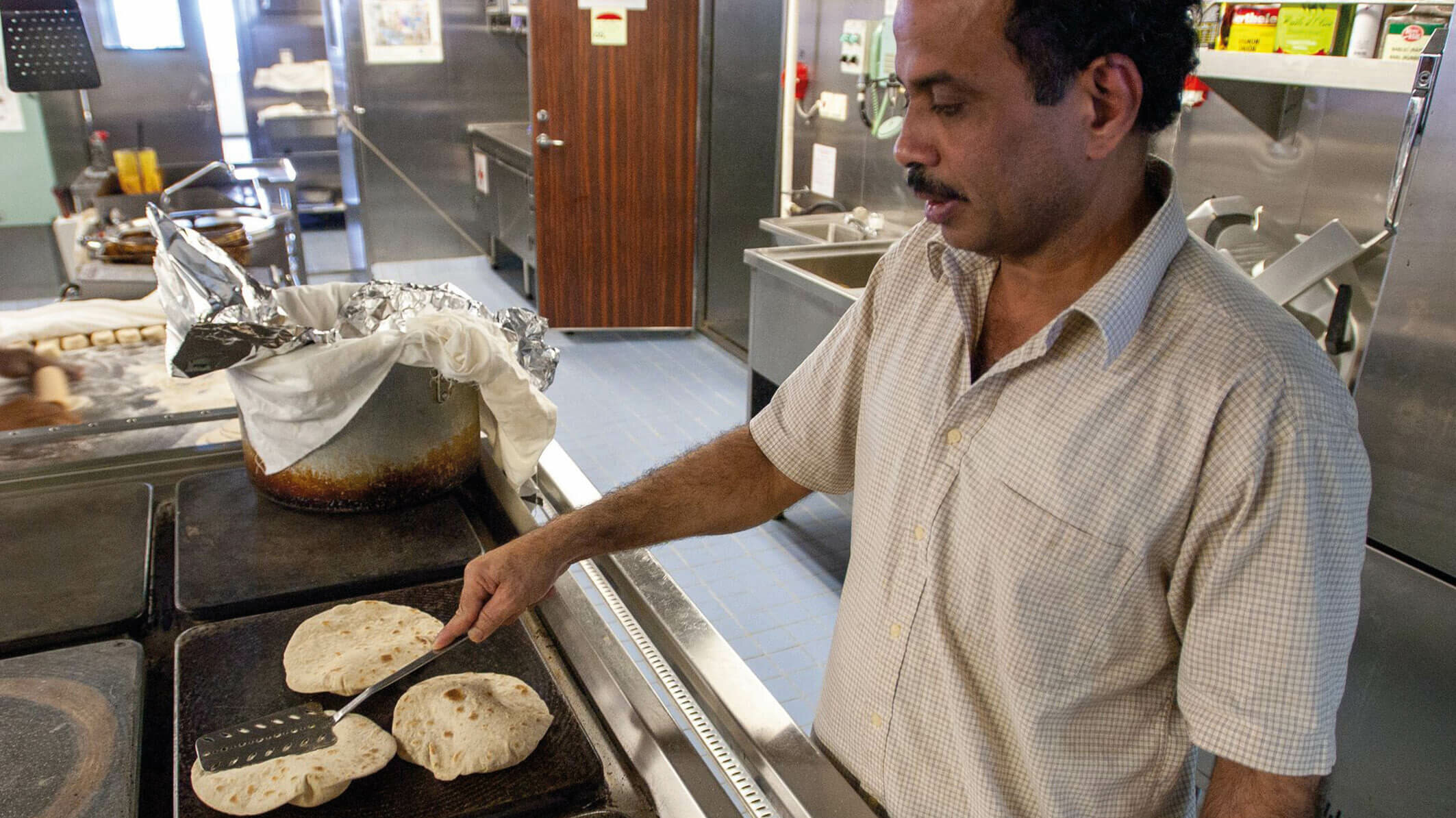
Food is a vital component for a happy ship
By Michael Grey
If an army marches on its stomach, a commercial ship’s efficiency and general wellbeing depends a great deal on what goes on in the galley. And it is a challenging job, satisfying the diverse tastes of an international crew, which has become thoroughly normalised in recent years. Good cooks, you might think, are heroic figures, turning out three meals a day 24/7, for people who work around the clock and probably have little time to leisurely savour the gastronomy, but will appreciate what is on their plates.
They also have an important role in keeping their fellow crew members healthy, although they may become weary of endless advice from ashore about calorie-counting and their responsibility for preventing overweight seafarers. It is upon their skill and subtle menu-engineering that those prone to eating what is not good for them can be persuaded to change their bad habits. And that is not easy. I remember the chief cook on a big freight ferry talking about the sheer struggle he had to persuade the road-haulier passengers that there was a better way of treating one’s body than filling it full of fat and carbohydrates. But that was exactly what the passengers wanted, and if there were not chips with everything (other than pudding), they would complain.
The role of the cook has changed markedly over the years. Tales of the long era of sail, heavy on accounts of scurvy and other food-related diseases, picture the cook as somebody who was forced to do a job that nobody wanted. Invariably the cook was somebody too old or disabled to go aloft and was expected to produce something vaguely edible from the disgusting raw materials provided by a parsimonious owner, and which would decay without refrigeration as the voyage ground on. Joseph Conrad is an excellent guide to sailing ship cookery, if further information is needed.
Moving with the times
The arrival of steamships saw some improvement, and the regulation of ships’ provisions, although there remained many owners who regarded these as an imposition and grudgingly provided only the bare statutory minimum, lest the crew ate the voyage profits. Eventually, more enlightened times arrived, along with better trained catering staff, and regulatory oversight from port state control, just to ensure short cuts were not being taken. There remains, as there always has been, a minority of ship operators who are unconcerned with the welfare of the seafarers they employ.
Modern times have seen the size of ships’ crews reduced substantially, and the number of people available to cook has also sharply reduced. A giant ship with a crew of twenty may typically have a single cook to cater for them, which means there will be little respite for this hard-worked individual, who invariably has to plan the menu in addition to cooking it.
Can this trend continue, with all the talk about AI and further automation? A cautionary tale comes from the 1980s and a scheme for a series of hugely advanced “ships of the future”, packed with advanced equipment and run by a miniscule crew of highly qualified seafarers. Which of these scientifically inclined seafarers would do the cooking? An initiative came from the airlines, and a plan to provide the ship with pre-cooked food, which could be extracted from a microwave at the touch of a button. Fortunately, somebody who was regrettably familiar with airline food vetoed the idea, at an early stage. A properly qualified cook was duly appointed to each ship.
1.89 million people work at sea, and with your help we can be there for everyone that needs us.