Resources
A collection of free resources to help you raise funds and share the work we do


About our charity
The Mission to Seafarers provides help to the 1.89 million people who face danger every day to keep our global economy afloat.

What is a seafarer
Support for anyone working in the seafaring industry
Our impact
Providing help for seafarers in over 200 ports around the world.
Our issues
Multiple issues effect Seafarers everyday, learn how we help
Our people
Learn more about the staff that make change happen
Careers
Impacts on the lives of people across the world
Publications
Explore our latest publications, reports, and stories showcasing the impact of our work.

Back
About our charity
The Mission to Seafarers provides help to the 1.89 million people who face danger every day to keep our global economy afloat.
What is a seafarer
Support for anyone working in the seafaring industry
Our impact
Providing help for seafarers in over 200 ports around the world.
Our issues
Multiple issues effect Seafarers everyday, learn how we help
Our people
Learn more about the staff that make change happen
Careers
Impacts on the lives of people across the world
Publications
Explore our latest publications, reports, and stories showcasing the impact of our work.

Where can I get help?
We are here for you 24/7

Download our app
The first digital seafarers’ centre in your pocket.

Find a port
We’re located in over 200 ports in 50 different countries
Family network
Learn more about the community we’re building for seafarers’ families
The Sea
The latest maritime news and safety information for seafarers.
WeCare
An initiative designed to improve the mental health and wellbeing of seafarers
Training
We have a range of e-learning for seafarers and their families
Seafarers happiness index
A platform for seafarers to share their views and be a catalyst for change
Contact our Chaplaincy team
Support for anyone working in the seafaring industry
Back
Where can I get help?
We are here for you 24/7
Download our app
The first digital seafarers’ centre in your pocket
Find a port
We’re located in over 200 ports in 50 different countries
Family network
Learn more about the community we’re building for seafarers’ families
The Sea
The latest maritime news and safety information for seafarers.
WeCare
An initiative designed to improve the mental health and wellbeing of seafarers
Training
We have a range of e-learning for seafarers and their families
Seafarers happiness index
A platform for seafarers to share their views and be a catalyst for change
Contact our Chaplaincy team
Support for anyone working in the seafaring industry

Make a donation
With your help we can be there for everyone that needs us

Events
Learn more about our global programme of events

Legacy
Support us with a legacy gift.
Back
Make a donation
With your help we can be there for everyone that needs us
Events
Learn more about our global programme of events
Legacy
Support us with a legacy gift.
Pioneering at-sea fresh food initiatives satisfy more than hunger
By Felicity Landon
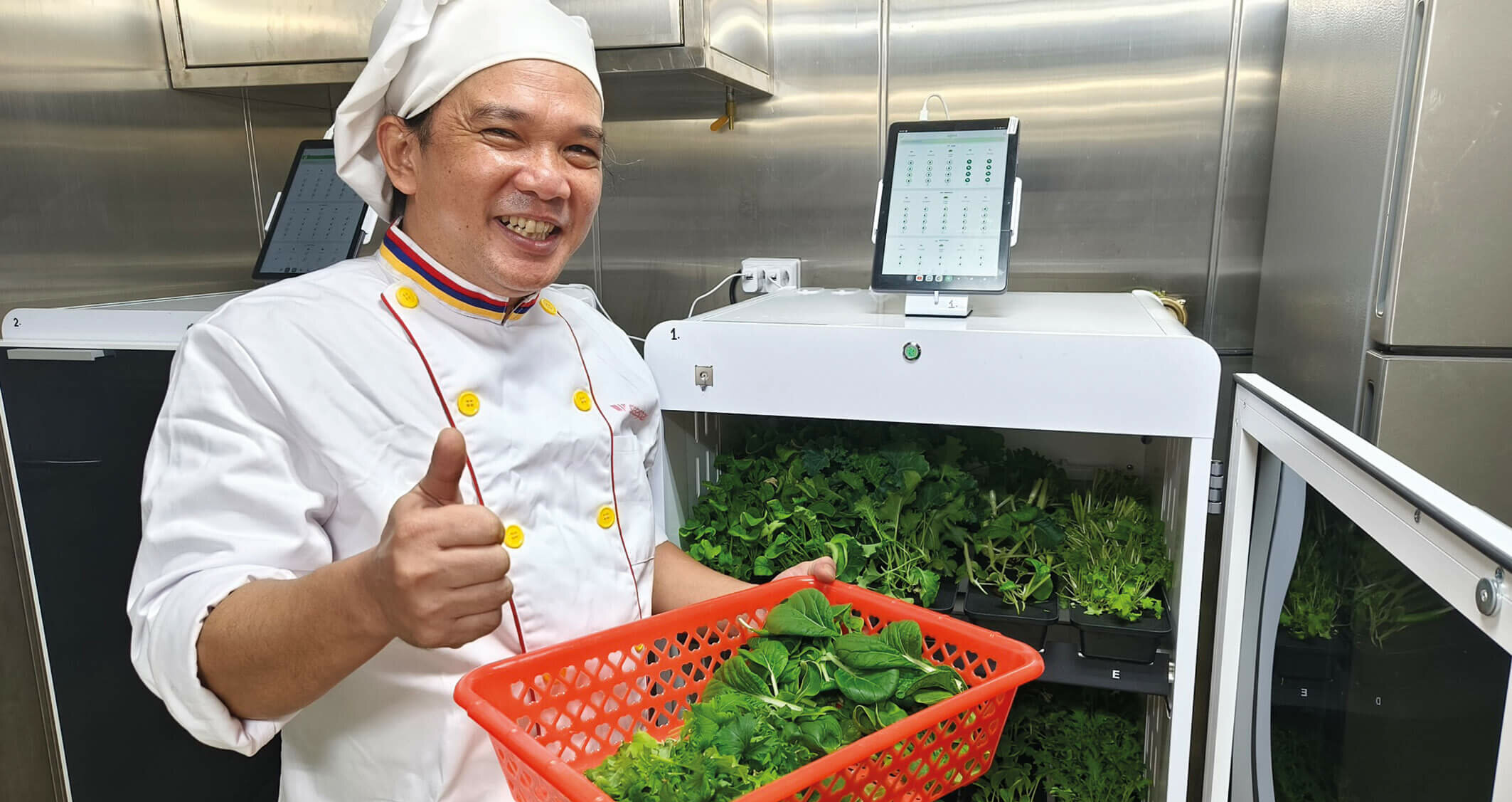
Would you like fresh salad with that? Or maybe a handful of just-picked parsley? We’re not in a restaurant or even making a quick trip to the supermarket here. We’re talking about serving meals to seafarers in the middle of the ocean.
Something new is, quite literally, growing. Providing access to fresh greens on board is part of a wider picture in which good nutrition is being recognised as vital – not only for the happiness and welfare of seafarers, but as a safety issue too.
Among companies offering technology to grow produce on board is Agwa. Its remotely operated, AI-controlled compact growing units are installed on about 400 vessels to date, and the company predicts that installations will be in the thousands in a few years’ time. Agwa was targeting domestic customers when it introduced its system five years ago, said Maayan Castel, vice president of product. “Then we recognised this need of the maritime industry for fresh food and started selling the system for vessels.”
The units are fitted with cameras and sensors to monitor nutrients, humidity, temperature and plant status and health; the system automatically injects nutrients and adjusts lighting, water, temperature or fans as required and instructions for when to harvest produce are delivered via an app.
“Currently we produce mainly greens and herbs – leaves for salad, parsley, cilantro, basil. The devices we are now working on will also be able to grow fruit such as strawberries and tomatoes,” said Castel. “The feedback from vessels is great – seafarers enjoy having variety on the menu. The other feedback is that there is a real impact on seafarers’ physical and mental health. They can feel that someone is taking care of them and the emotional effect is huge.
“We tend to hear more about the welfare part, but it is also the nutritional value. When you give someone good food, it directly affects their focus and motivation; studies show the connection between healthy, fresh, nutritious food and people’s ability to perform.”
These units do not add to the onboard work, she emphasised. Because they are based on pre-seeded capsules and are fully automated once connected to water and Wi-Fi, seafarers do not find themselves taking on the care of plants at the end of a demanding shift.
Among those using the system are Synergy, Seaspan and Eastern Pacific Shipping (EPS). Arpit Jain, senior manager at Fleet Management Pte Ltd, said: “Agwa is not only a healthy organic option – it’s good for mental wellness. Many of the crew told me they spend some time after their watches near the Agwa pods; seeing the greenery and watching the plants grow gives them mental peace in the midocean.”
Capt Deepak Joshi, master of the EPS’ Sunrise Ray, said: “The experience of being able to produce fresh greens for daily consumption has been an unreal one. It has given us the opportunity to provide the crew with a variety of fresh salads daily, breaking the monotony of having frozen food most of the time.”
Boost for effectiveness
At sea, where seafarers live and work in the same environment for extended periods, nutrition is not simply a welfare benefit but a fundamental component of maintaining a healthy, engaged and effective crew, said Kyriakos Hadjikyriakou, Managing Director at maritime catering specialist Oceanic. “Food is one of the few features of daily life on board that directly affects every seafarer, every single day. Good nutrition contributes to physical health, mental wellbeing, energy levels and social cohesion. Equally, poor nutrition can contribute to fatigue, reduced concentration, increased health risks and lower morale,” he said. “Food plays a major role in morale and quality of life on board. A well-prepared meal can provide comfort, familiarity and a sense of normality during long periods away from family. Seafarers consistently describe food as one of the most important factors in their onboard experience.”
From a safety and performance perspective, nutrition directly affects physical and cognitive function, Hadjikyriakou added. “Healthy eating habits support sustained energy levels, concentration, alertness and overall fitness. These factors are particularly important in the shipping industry, where fatigue management, awareness and sound decision-making are critical to safe operations.”
Increasingly, more companies recognise the impact nutrition plays in morale, commitment, safe operations and retention, he added. “The shift has been gradual, but it gained momentum since Covid-19, when the entire industry realised the vulnerability and exposure of seafarers in a world that cannot function without them.”
Today’s seafarers are more health conscious than previous generations, said Hadjikyriakou, with many being increasingly aware of the relationship between diet, energy levels, weight management, fitness and long-term health. “However, awareness does not always translate into behaviour. Seafarers may still go for foods that are familiar, comforting or higher in sugar/salt/fat, particularly when they are feeling stressed or fatigued.”
The objective, he said, should not be to police people’s choices, but to create an environment where healthier options are attractive, accessible and enjoyable. “When nutritious meals are well prepared, varied and culturally appropriate, healthy eating becomes much easier to encourage.”
Core investment
Lorraine Hagar, senior loss prevention executive at The Swedish Club, said crew nutrition should be seen in the same context as investing in training, maintenance or safety management systems. “You won’t see nutrition appearing as a direct cause in an accident report – but nutrition influences many of the factors that increase risk, including fatigue. If you’re eating the wrong type of food, perhaps too many carbohydrates for example, then the body reacts differently and you may get easily tired.”
Poor nutrition can reduce concentration and impair decision-making and physical wellbeing, said Hagar. “The relationship between fatigue and safety performance is well established in the maritime sector, as we all know, with fatigue recognised as a significant contributor to operational errors and accidents at sea. A poorly nourished seafarer who is fatigued and struggling with energy fluctuations, is less equipped to perform safety-critical tasks effectively.”
In the Swedish Club’s ‘Check Your Pulse’ seafarer wellbeing initiative, nutrition is recognised as one of the key pillars supporting health, resilience and the performance of seafarers. “For us, from a loss prevention perspective, incidents rarely occur because of one single failure. More often, they result from a combination of human, operational and organisational factors,” said Hager.
“The shipping industry has traditionally invested heavily in maintaining vessels, machinery, equipment. But we always say that the most important asset on board remains the crew. Good nutrition supports alertness and concentration, physical endurance and recovery from demanding work schedules. If you’re eating well, then the body is probably working better.”
The Check Your Pulse modules are designed to reduce risk and promote reliable performance, which goes hand-in-hand with seafarer wellbeing, she explained. “Most importantly, they also reflect the commitment of an organisation to its people. The quality of food provided sends a clear message about how a company values its crew. Also, a positive onboard food culture improves the morale of the crew. For a multicultural crew, if a company provides different, nutritious food on board it can also encourage social interaction and strengthen the cohesion of the crew.
“Beyond that, it should also enhance retention and job satisfaction – which in turn means that you retain the expertise of your crew and spend less time training new people who are not used to the operations on board.”
Hagar also emphasised the need to educate and explain. “If you teach people about good nutrition and what type of food is going to help them stay more awake and healthier, I think they would feel valued and supported and would be more likely to be engaged and proactive. People may be used to how things have been done before – they might ask, why do we need to change, why do I need to have fresh produce? The mentality needs to change on board as well and that’s going to be one of the challenges as seafarers can be very much in their routines.”
Deeper connection
Hadjikyriakou reflected on the importance of good quality food and well-balanced meals “that touch the heart and soul and connect the seafarer with their culture or community”.
A good healthy nutritious meal helps with the physical and mental health, but good food is also a time when people talk, he pointed out. Onshore, we go to a restaurant to enjoy nice food and talk, exchange ideas and share the experience. If the restaurant and food are poor, we would likely be eating quickly and not bothering to socialise.
It’s the same with seafarers, he said, except that for those at sea, if the food is poor, with no variety and no attention to detail, they have to endure this every day for months at a time. “Then imagine you step into the mess and find a nicely presented buffet and see the care taken by the chief cook – it shows appreciation of what you do, and your state of mind is different.”
For seafarers, the food on board says a lot about owners and managers, he said. If they can see that effort has been made to deliver a pleasant and enjoyable experience, they are likely to feel more positive about who they are working for and more likely to want to stay with the vessel.
It’s easy to imagine seafarers eating healthy food provided on board then returning home to their favourite, possibly unhealthy dishes. Oceanic goes beyond what’s eaten on board, getting seafarers’ families involved too. Seafarers’ families are invited to the Oceanic training centre to learn about nutrition and alternative cooking methods and do some live cooking with the trainers.
“Through our dedicated health and wellbeing department, we promote healthy living through wellbeing initiatives, health promotion campaigns and challenges, educational resources and ongoing engagement with the vessels we serve on healthy eating practices,” Hadjikyriakou said. “We also recognise the important role of training, particularly for galley crew, in supporting the preparation of nutritious, balanced and appealing meals.
“Our focus is on creating onboard environments where healthier choices are accessible, attractive and sustainable, while respecting the cultural diversity and personal preferences of seafarers. We believe that investing in nutrition is an investment in the seafarers who keep global trade moving, supporting their wellbeing, resilience and ability to perform safely and effectively at sea.”
Hager added: “A healthy crew is a healthy ship. Good food supports morale and crew engagement. These are the factors that directly contribute to safer operations and better overall vessel performance.”
The final word goes to an anonymous officer, who wrote thanking Agwa for its support. “We are currently operating in a sensitive and high-awareness environment in the Gulf, where security considerations and operational pressure remain elevated,” the officer wrote. “Despite this, the crew remains focused, professional and committed to maintaining safe and efficient operations on board.
“Your support through Agwa has had a very positive and tangible impact on board. The availability of fresh produce grown directly on the vessel is a significant improvement compared to traditional supply limitations at sea. It enhances not only the quality of nutrition but also contributes greatly to crew morale, daily routine and overall wellbeing. Having access to fresh, healthy food throughout the voyage makes a real difference, especially during extended periods away from ports.
“Beyond nutrition, the presence of Agwa on board brings a sense of normality and positivity to daily life, supporting both physical and mental wellbeing of the crew during challenging operations.”
1.89 million people work at sea, and with your help we can be there for everyone that needs us.